

 Ukrainian
RHODESIAN RIDGEBACK FCI Standard No. 146, 2000
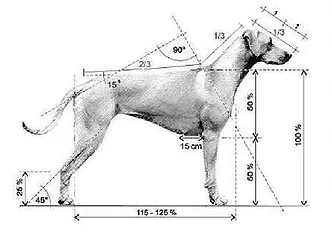
General view: Harmonious, strong, muscular, active, noble lines, combining qualities such as speed and endurance. Produces the impression of power in combination with swiftness, but without heaviness. A characteristic breed sign is the “ridge” on the back, formed by wool, growing in the direction opposite to the rest of the dog’s woolen cover. Ridge should be pronounced, symmetrical, start immediately behind the withers and, continuing to the rump. To narrow to the end, reaching the pelvic bones. Ridge has only two identical and symmetrical curls (“crown”), the lower edges of which should not fall below 1/3 of the length of the ridge. The width of the right ridge is usually about 5 cm.
Character: the dog is intelligent, self-confident, indifferent to strangers. Does not show aggression, but does not show shyness.
A head: Cranial part: Proportions of the skull: A head is of sufficient length (the distance between the ears is equal to the length of the skull from the occiput to the transition, and in turn is equal to the length of the muzzle from the transition to the nose), the skull is flat, preferably wide between the ears, free from wrinkles.
The transition: the transition is fairly well expressed.
Front:
Nose: lobe of the nose black or brown, depending on the wool color. Dark eyes correspond to black nose, brown – amber.
The muzzle: the muzzle is long, deep, strongly molded.
The lips: the lips are dry and tight.
Jaws and teeth: Jaws are strong, perfect shape, scissor bite. Teeth are strong and large, especially fangs.
Eyes: Planted moderately broad, roundish, their color corresponds to the color of the wool. Expression – attentive and intelligent.
The Ears: Planted relatively high, hanging, medium in size, slightly wide at the base, gradually narrowing towards rounded ends, pressed to the head.
Neck: Long, strong, free from suspension.
The body:
The back: The back is sturdy.
The loin: The loin is strong, muscular, slightly convex.
The chest: The chest not too wide, very deep, lowered to the elbow joint.
Handle of sternum (forbrust): Well developed, visible from the side.
Ribs: Ribs moderately arched, thorax in no case barrel-shaped.
Tail: tapering to the end, free from rudeness, worn with a slight bend upwards, never folded into a ring.
Limbs:Forequarters: Shoulders are sloping, muscular. The limbs are completely straight, strong, with strong bones, elbows close to the body. Pasterns are strong, slightly inclined when viewed in profile.
Hindquarters: With strong, dry muscles, with good angles, the metatarsus is relatively short, steeply set.
Paws: Compact, the fingers are collected together, the pads are round, dense and elastic.
Movement: Loose and springy.
Wool covering: The wool is short and dense, close fitting, smooth and shiny. Not rough or silky.
The color: From light-red to red-red. Head, body, legs and tail of the same tone. A little white on the chest and on the fingers is allowed, but excess white wool on these places, belly and above the fingers are undesirable. Maybe a black mask. Black wool throughout the body is extremely undesirable.
Sizes: Growth of males at the withers is 63-69 cm, female – 61-66 cm. Weight is 32-36,5 kg.
Note: Males should have two normally developed testicles fully descended into the scrotum.
Disadvantages: All deviations from the above standard are drawbacks, the severity of which depends on the degree of their severity.
Comments on the breed standard of RHODESIAN RIDGEBACK
(made by G.Eva after the national exhibition in Moscow in April 2002) G.Eva – is an FCI expert on all breeds, the president of the South African Cannell Union, one of the developers of the breed standard
As an introduction, Mr. G.Eva said that he liked the quality of the dogs. Most dogs were of the same type, which he considers to be correct. Although he judged much more harshly than 3 years ago (at the national exhibition in 1999), 26 of the 34 submitted Rhodesian Ridgebacks, rated “excellent”, really deserve it. These dogs can be adequately exhibited at major international exhibitions. It can be seen that for 3 years a lot of work has been done, and the quality of Russian dogs has grown substantially.
What does the right type mean: It is very important that all the proportions of the dog help to fulfill the basic function – running. The type of dog should in no case resemble a Dogg. There must be a balance of strength and elegance. Need smooth lines of the neck, back, rump. Sharp undermining is not permissible. Everything in the dog should be harmonious. The fastest way to check how well the dog is stacked is to put it in the rack. Pull out the tip of the tail and look. From the tip of the tail to the nose, there should be a perfectly straight line.
A head: a head seems to be the most important part. A good head, as a rule, corresponds to a good body. When viewed from above, the head should look like the head of a cobra, ready to be struck, and have the shape of a triangle. A dog should have a typical expression of a cobra.
The Ears: The ears should be tightly pressed to the cheekbones.
The muzzle: The muzzle should not be long, because the head loses the likeness of a snake, almost triangular. The distance between the ears should be equal to the length of the muzzle.
The body: The body must be slightly stretched, in no case square, so that when running, the hind legs will not interfere with the forelegs. The numerical ratio (index) of stretching does not exist, simply the dog should look harmonious. The dog should be compact, rather of medium size, with good, but not excessive musculature. Muscles should be embossed, well readable, but the dog should not be too pumped up, so that there is no feeling that the skin is about to burst. A loaded dog is not capable of free and easy movements, which are very important when running.
The сhest: The chest should be deep enough, at least up to the elbow, so that there is enough room for the lungs and the heart while running.
The loin: The loin should be sturdy so that the hind legs can effectively work when moving.
The corners of extremities: The corners of extremities should be well expressed. Shoulder should not be straight, because otherwise there is no swinging of the forelimbs when moving. The hind legs should have sufficient angles to provide a powerful push that throws out the entire body weight of the dog when running.
Limbs: Limbs should be parallel, so that when running, move in parallel planes. If the motion loses straightness, as soon as there is a wobble, there is a dispersion of energy into excess motions. Inverted elbows are unacceptable, such dogs should not be allowed into breeding.
The pastern: The pastern should be strong, but not vertical, to spring when the paw strikes the ground.
Paws: Paws – are feline, collected, not disbanded in any way. The paw pads are strong so that the dog can travel long distances.
Claws: The claws should not be unnecessarily worn out or clipped so that the dog can cling to and run from the ground when running.
Ridge: The crown must begin from the shoulder line. Ridge should be even, without bends, pass all over the back, evenly tapering and coming to naught in the end. The end of the ridge must be no more than the maklak. (In Europe, such dogs are seriously penalized). Dogs, in which ridge reaches maklak, are extremely rare. A sufficient length of ridge is considered if it starts on the shoulder line and ends at the waist. The most important is where the ridge begins. Worse if the ridge starts too low, than ends too high. The good width of the ridge is 5 cm between the centers of the curls. Worse if the ridge is narrower than the wider one. Curls should be two, they should settle against each other. The top line of the crown can be any. A small asymmetry of the curls (higher, lower) is permissible. (In one dog – the winner of the class – the asymmetry of the curls was 7-8 mm.)
The color: The standard says: “from light-wheat to red-wheat color”. Greg Eva mentioned that he himself does not understand this formulation (which was introduced a long time ago). In the development of the new 2000 edition of the standard, they have spent 6 months on clarifying it, but so far it has not been done. This refers to the yellow (golden) hue of ripe wheat. Gray color is not allowed. Inadmissible as too light fawn color, and too dark – brown. White spots are allowed on the chest and on the paws (not above the level of the fingers). This issue should worry the breeders more so that when breeding, do not allow white marks. A black mask is permissible. It is desirable that it was bright, intensely colored. The presence or absence of a mask can’t be a criterion for the quality of a dog.
Height: 63-69cm (for males). But 62 and 70cm are also acceptable if the dog looks harmonious. In the homeland of the Ridgebacks, as a rule, they are of medium size, but breaking away from Africa to Europe and America, they have greatly increased in growth. This is a reality that must be taken into account.